
Why Music Makes Us Emotional
A song can make us smile, cry or suddenly remember a moment we have not thought about in years. Why does music have such extraordinary access to our memories and emotions?

You hear the first few seconds of a song you have not listened to in years — and suddenly you are somewhere else.
A road trip. A wedding. Your childhood bedroom. Someone you used to know.
Nothing around you has changed, yet for a moment the past feels surprisingly close.
Music has an unusual ability to connect sound with emotion, personal meaning and autobiographical memory. It is one reason a song can feel like much more than entertainment.
Music gives emotion a shape
Emotions can be difficult to describe. We often know what we feel long before we know how to explain it.
Music does not need to describe sadness, anticipation, tenderness or joy directly. Melody, rhythm, harmony, dynamics and the human voice can create those sensations without explaining them in words.
This is part of the reason music works so well during the most emotionally important moments of life: weddings, celebrations, funerals, first dances, family gatherings and goodbyes.
Why does one song bring back so many memories?
We rarely experience music in isolation.
Songs play while other things are happening. We listen while travelling, falling in love, spending time with friends, celebrating birthdays or simply living through an important period of our lives.
Over time, the music becomes connected to those experiences. Hearing it again can act as a cue that helps bring related memories back into awareness.
The soundtrack of our lives
Most people can identify songs that seem inseparable from a particular period of their life.
The song itself may not even be exceptional. What makes it powerful is what happened around it.
The track you played endlessly at seventeen. The song from your first dance. The music your father always played in the car. The record your mother loved.
With enough personal association, music begins to function almost like an emotional photograph.
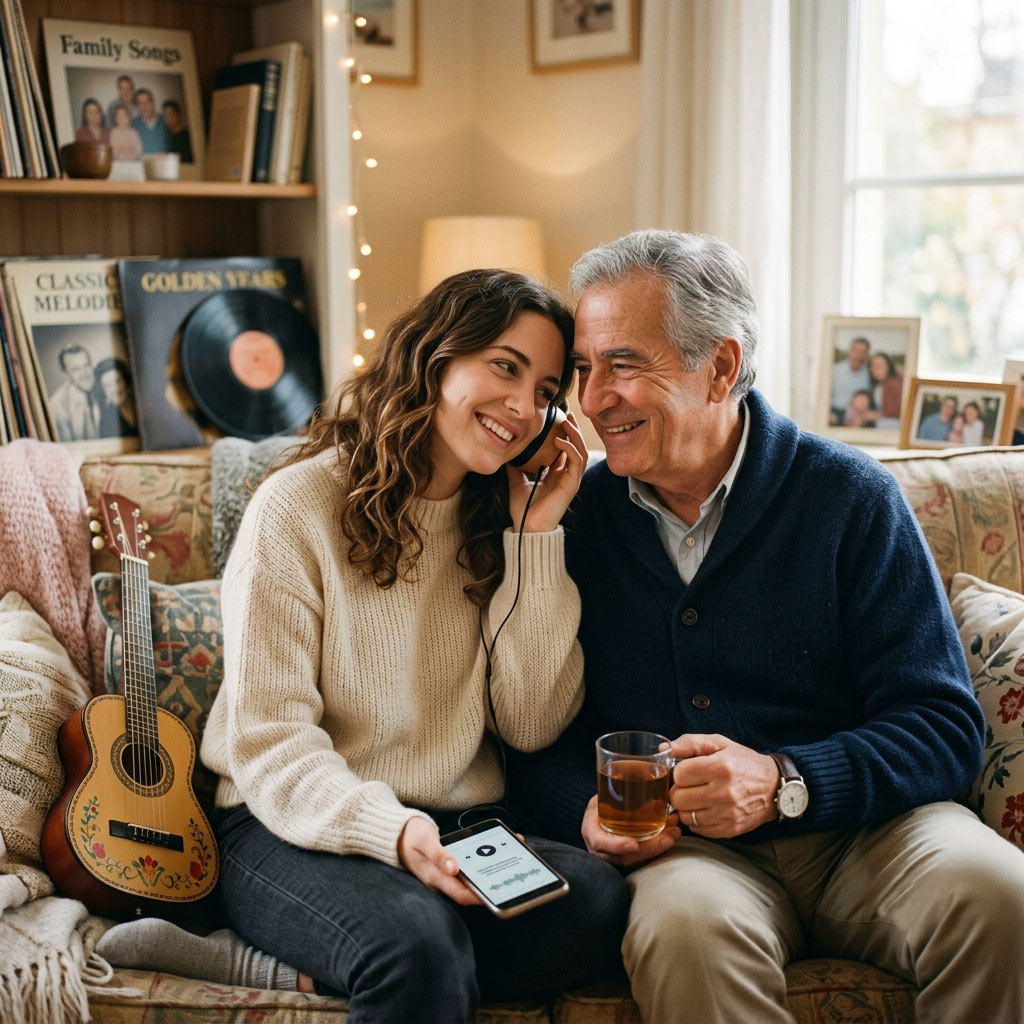
Why familiar songs can feel comforting
Familiarity changes the way we experience music. Once we know a song well, we begin to anticipate what comes next.
We know when the chorus will arrive, when the harmony will change and when the voice will reach the line we love.
That combination of recognition and anticipation can make familiar music feel safe, satisfying and emotionally powerful.
It also explains why people often return to the same music during difficult or important moments.
Why personalized music can feel even more powerful
Most songs become personal because we attach our own experiences to them over time.
A personalized song works in the opposite direction.
The personal story is there from the beginning.
Names, places, shared jokes, important dates, difficult moments and memories can become part of the lyrics themselves.
An ordinary song can eventually remind you of your story. A personalized song begins with your story and turns it into music.
Lyrics add another layer of memory
Instrumental music can communicate emotion without language, but lyrics introduce something else: narrative.
Words allow a song to name people, describe moments and place events in sequence.
This is especially powerful when the listener recognizes details that could belong only to them.
A street name. A holiday. A nickname. The way two people met. Something their children always say.
Those details transform the experience from “this song reminds me of us” into “this song is about us.”
Music and photographs work differently — and beautifully together
Photographs give memories a visual anchor. Music gives them rhythm, atmosphere and emotional movement.
Combining the two can make familiar images feel surprisingly different.
A collection of photographs becomes a sequence. A sequence becomes a story. And music helps determine how that story feels.
That is why sound is such an important part of a Memory Video Album. The photographs preserve what happened; the soundtrack helps recreate how the memories feel.
Music can preserve relationships as well as moments
Many of our strongest memories are social.
They involve parents, partners, children, grandparents, friends and people who once shared an important part of our lives.
Music can become connected not only to an event but to a person.
Years later, hearing that music can make their presence feel strangely close again.
That emotional connection is one reason music appears so naturally in rituals of remembrance, celebration and family storytelling.
The song does not contain the memory. You do.
This may be the most beautiful part.
A piece of music cannot literally store your first dance, a childhood summer or your father's laugh.
Those memories belong to you.
The music simply becomes a key.
And sometimes only a few notes are needed to open the door.
Turning a memory into something that can be shared
Music is powerful because it can transform an internal memory into something another person can experience with us.
A story can become lyrics. Photographs can become a film. A familiar voice can become part of a memory piece. A family's history can even become a personalized movie.
The format changes. The purpose remains surprisingly human: to tell someone, “this mattered to me — and so did you.”
And perhaps that is why music makes us emotional. It does not simply accompany our lives. Eventually, parts of our lives begin to live inside it.
What would their story sound like as a song?
Tell us about the person, the memories and the moments that matter. We'll turn them into something made only for them.
Create a Personalized Song →